How a Nitrogen Booster Pump Improves Industrial Efficiency?
In many industrial and laboratory settings, the pressure provided by standard nitrogen supply often falls short of the demands of high-pressure processes. This is where a nitrogen booster pump comes into play, it can quickly elevate low-pressure nitrogen to the required working pressure, ensuring smooth production operations while keeping equipment stable and reliable.
From chemical and petrochemical industries to food processing, pharmaceuticals, and even aerospace, nitrogen booster pumps have become an indispensable high-pressure “booster” in modern industry. They not only maintain a stable pressure supply but also play a critical role in improving production efficiency and safety.
Working Principle of a Nitrogen Booster Pump
The core function of a nitrogen booster pump is to increase low-pressure nitrogen to high-pressure output, meeting the demands of industrial and laboratory applications. Its working principle mainly relies on mechanical compression or an air-driven system, with precise components working together to ensure stable and safe pressure output.
1. Main Components
Pump Body
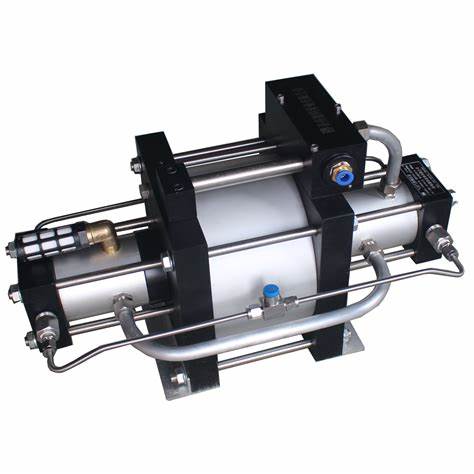
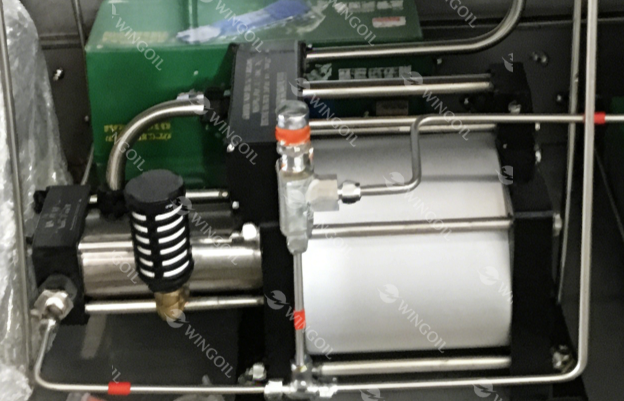
The pump body is the core of the nitrogen booster pump, responsible for gas intake, compression, and delivery. Its internal structure is designed for efficient pressure boosting within a compact space.
Valve System
The valve system, including the intake and outlet valves, controls the direction of gas flow. The intake valve ensures low-pressure nitrogen enters the pump smoothly, while the outlet valve allows high-pressure nitrogen to exit steadily and prevents backflow, ensuring a safe and reliable boosting process.
Seals
Seals prevent gas leakage and maintain system stability. High-quality seals can withstand high-pressure conditions and reduce wear over long-term operation, extending the service life of the pump.
Drive Mechanism
Nitrogen booster pumps can be driven either by air or electricity:
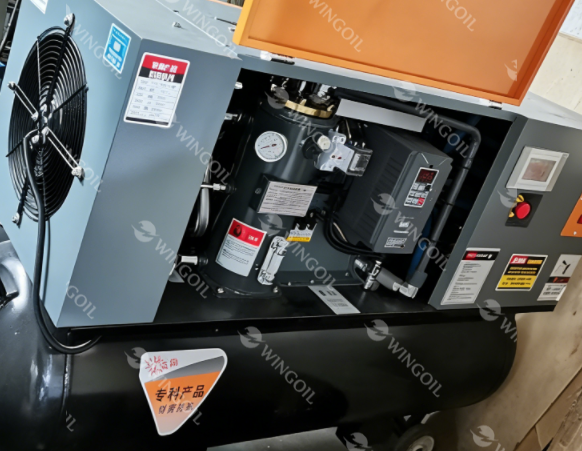
Air-Driven Pumps: Use compressed air to push pistons or diaphragms, making them simple, heat-resistant, and suitable for flammable or explosive environments.
Electric Pumps: Use a motor to directly drive the pump body, ideal for applications requiring precise control of pressure and flow.
2. Boosting Process
The working process of a nitrogen booster pump can be divided into several key steps:
Inlet: Low-pressure nitrogen enters the pump through the intake valve. The latter works as a one-way channel so that the carrier gas is only sucked up by the pump.
Compression and Supervening: Inside the pump, nitrogen is squeezed by a piston or diaphragm to achieve the present pressure required. The pressure-generating principle in an air-driven unit demands an air pressure volume working a piston or diaphragm, while an electric unit operates by itself, driving the diaphragm compression.
Outlet: The nitrogen is released from the output valve, having a higher pressure than that sucked in, and then delivered into the processing equipment or system that requires the high pressure of gas. The outlet valve also allows uniform flow and backflow prevention in systems.
Circulation and Control: The pump body, valves, and transmission function in combination to constantly keep the pressure in subsequent circulation at a uniform output. In other cases, the pumps include pressure transducers, and controlling software, which keep the pressure and speed of the pumps in the automatic boost, rendering it safer and more efficient.
Through the combined efforts of these components and processes, a nitrogen booster pump can effectively and reliably change low-pressure nitrogen to high-pressure gas that serves for various industrial and lab applications.
Main Applications of Nitrogen Booster Pumps
Nitrogen booster pumps play a critical role across multiple industries. By reliably increasing low-pressure nitrogen to high-pressure output, they not only ensure a stable gas supply but also support production efficiency, equipment safety, and product quality. Here’s a detailed look at applications of nitrogen booster pumps:
1. Industrial Production
In the petrochemical, chemical, and diverse manufacturing segments, high-pressure nitrogen is much-needed for various operations. Commonly, high-pressure nitrogen uses nitrogen booster pumps in supply for:
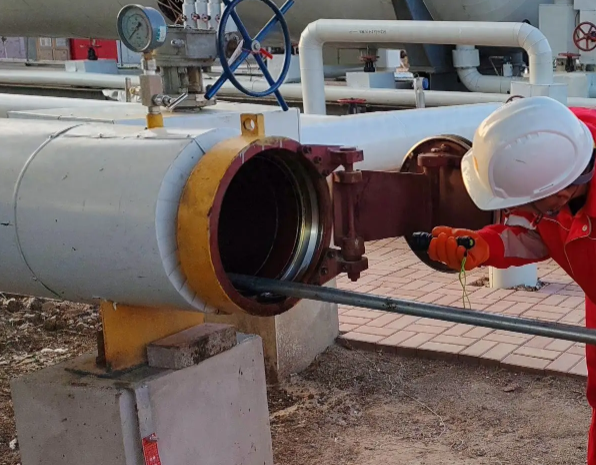
Pipeline Pressure Testing: which provides steady high-pressure nitrogen to test the integrity and pressure tolerance of pipes or storage tanks, thereby ensuring equipment inclusiveness.
Pressure Regulation: which is often used in gas pressure control during the manufacturing process, enabling super-precise process parameter manipulation.
Equipment Cleaning and Purging: conferring the brought-about-use of high-pressure nitrogen for clearing residual substances from piping or vessels, rendering enhancement of operational efficiency.
Fire and Explosion Prevention: it can prevent exposure to blast or fire dangers through inerting in naturally flammable or explosive situations by minimizing the oxygen level therein.
2. Laboratories and Testing
High-precision laboratory equipment and testing instruments require extremely stable gas pressure, which nitrogen booster pumps can provide:
Stable High-Pressure Supply: Ensuring consistent gas pressure during experiments or tests, preventing deviations in results due to pressure fluctuations.
Precision Control: Some pumps come with pressure adjustment and monitoring systems, allowing accurate output regulation to enhance repeatability and reliability.
Wide Applications: Suitable for physics and chemistry experiments, gas chromatographs, mass spectrometers, and other research instruments, providing a stable gas source for scientific analysis.
3. Food and Pharmaceutical Industries
In food processing and pharmaceutical production, high-purity nitrogen is widely used for oxidation prevention, preservation, sterilization, and aseptic packaging:
Oxidation Prevention and Preservation: High-pressure nitrogen displaces air in packaging and processing, extending shelf life.
Sterilization: Nitrogen, combined with other processes, helps sterilize or control microbial growth, ensuring product safety.
Stable Supply: nitrogen booster pumps provide continuous and consistent high-pressure nitrogen to production lines, preventing process interruptions or quality issues caused by insufficient pressure.
In addition, nitrogen booster pumps are also widely used in aerospace, electronics manufacturing, and precision instrument production. Essentially, any scenario that requires high-pressure nitrogen, stable output, or a safe inert atmosphere may benefit from this type of equipment.
Advantages of Using a Nitrogen Booster Pump
Nitrogen booster pumps offer multiple advantages in industrial and laboratory applications. They not only enhance operational safety but also improve efficiency and promote energy savings, making them an essential solution for high-pressure nitrogen supply in modern industry.
1. Enhanced Safety
Safety is clearly the most important advantage with respect to the nitrogen booster pump. To pump nitrogen up to pressure, this ensures no precipitous changes in pressure during operations or errors in operation, which is often crucial with the pipeline testing, chemical reaction, or precision equipment operation.
Furthermore, operation without electricity in such an air-driven nitrogen booster pump makes its use invaluable in potentially flammable or highly explosive areas or where sensitivity to electrical disturbances is a problem, minimizing the possibility of a fire or an explosion and ensuring a safe work environment.
2. Improved Production Efficiency
Nitrogen booster pumps can rapidly elevate low-pressure nitrogen to the required high pressure, ensuring continuous operation of production lines. Compared to traditional methods using high-pressure storage tanks or multi-stage compressors, booster pumps can:
Reduce waiting times: Equipment no longer needs to pause due to insufficient nitrogen pressure.
Accelerate process flow: High-pressure nitrogen is delivered on-demand, speeding up production cycles.
Support precision operations: Stable high-pressure nitrogen ensures accurate performance of laboratory instruments and industrial processes.
These advantages help significantly boost overall production efficiency while minimizing downtime and idle equipment periods.
3. Energy Saving and Environmental Benefits
Energy-efficient air-drive nitrogen booster pumps with zero emissions are friendly to environment promoting the ethos of sustainable development. Moreover, steady operation will definitely limit wear and tear of system gear by continued start-stepping or erratic motion:
- Extend the lifespan of equipment and systems
- Lower maintenance frequency and costs
- Save energy and improve overall operational efficiency
- Aids in lowering nitrogen waste levels, concurrently safeguarding the cost-effectiveness and efficiency of gas utilities.
Nitrogen booster pumps don’t just promote safety and productivity but also energy and environment conservation, becoming a true requirement for any high-pressure nitrogen applications within the industry today.
Maintenance and Troubleshooting of Nitrogen Booster Pump
To ensure long-term stable and efficient operation, regular maintenance and timely troubleshooting of nitrogen booster pumps are essential. Proper maintenance not only extends the equipment’s lifespan but also guarantees production safety and reduces downtime caused by pump failures.
Daily Maintenance
Inspect the Pump Body and Valves
Regularly check the pump body and valves for signs of wear, corrosion, or cracks. Ensure that all valves operate smoothly and maintain proper sealing. If any abnormalities are found, repair or replace the affected components immediately to prevent further damage or gas leakage.
Clean the Pipelines and Seals
Over time seal and pipeline can gather dust, debris, or sediment which either retard gas flow or reduce pressure. Regular cleaning of the inner pipelines alongside seating surfaces guarantees smooth passage of nitrogen and keeps boosting mechanism working effectively and system stable.
Replace Wearable Components
Change the following components, the valve plates, seals, pistons, and diaphragms, keeping in mind their wear and ageing through usage. Keep performance stable by replacing the components due to their wear according to the conditions under which the pump operates to prevent downtime or safety issues due to failed parts.
Check the Drive System
For air-driven pumps, inspect the compressed air source to ensure it is clean and maintains a stable pressure, preventing contamination or insufficient pressure from affecting pump performance. For electric pumps, verify that the motor operates normally without abnormal vibrations or overheating, and ensure all transmission connections are securely fastened.
Common Issues and Solutions
Insufficient Pressure
The pressure drop is not new to this kind of a problem. First, check that the air supply for pump drive is in stable condition and the pressure of air is as per the requirement. For the electric pump, ensure that the motor is running smoothly and check the pump for any blockages. Therefore, check if the valves are jammed or leaking. Most likely these repairs will restore normal pressure to the pump output.
Gas Leaks
Gas leak may develop in the pump’s body, seals, or pipeline connections. Make sure that the seals are not worn out, damaged, or inserted incorrectly. Additionally, valves and all lines are tightly secure. Seals that are found leaking should be replaced immediately to avoid further leakage and hazardous situations.
Excessive Noise
Most of the time, excessive noise from the pump indicates wear of some internal components or some loose parts. Study carefully the wear of pistons, diaphragm, and valve, and the manner of installation. Ensure that the drive system works smoothly with no abnormal vibrations and friction for the quiet operation of your pump.
Nitrogen booster pumps can run efficiently and highly reliably as the result of proper daily treatment and proactive intervention if problems develop. Pump lifespans increase considerably, simultaneously benefiting the plant with reduced periods of downtime, safety, and uninterrupted production process maintenance.
How to the Right Nitrogen Booster Pump?
Each nitrogen booster pump must be chosen, keeping in mind a wide set of parameters fitting the pump requirements for the given application. These various considerations need to ensure that you are getting what you need for a particular application.
Pressure and Flow Requirements
First, the output pressure and flow need to be determined according to the specific needs. For instance, different needs may be required for pipeline tests, lab equipment, or production lines for high-pressure supply. A suitable pump needs to be selected according to the needs to ensure proper efficiency without any problems due to insufficient pressure or flow.
Drive Type
Typical nitrogen booster pumps come in air drive type as well as electric model. Air-driven pumps do not require electricity and are used in hazardous, inflammable, explosive, or off-grid environments, providing a higher level of safety. Electric drives are preferred in industrial environments with secure electrical supply owing to better efficiency and continuous stable high-pressure output. Proper drive selection for simple operation in a specific environment while ensuring safety would be rewarding.
Material Selection
The operating environment often dictates the material of the pump body and valves. In high-temperature, high-corrosion, or chemically aggressive environments, pumps made of corrosion-resistant stainless steel or special alloys are recommended to ensure long-term reliable operation and extended service life. For standard environments, conventional metal materials are generally sufficient.
Brand Reputation and After-Sales Support
Choosing a reputable brand that receives excellent reviews from customers and ensuring manufacturer support such as warranty and after-sales service guarantees are indicators of product quality and dependability as per performance. It also ensures that the associated technical support exists in the case of a technical malfunction.
With conformity to key flow rates, drive type, casing materials, and support from the brand, choosing the most suitable nitrogen booster pump for your application guarantees an efficient, safe, and stable high-pressure gas supply.
Recommendation: Wingoil Nitrogen Booster System
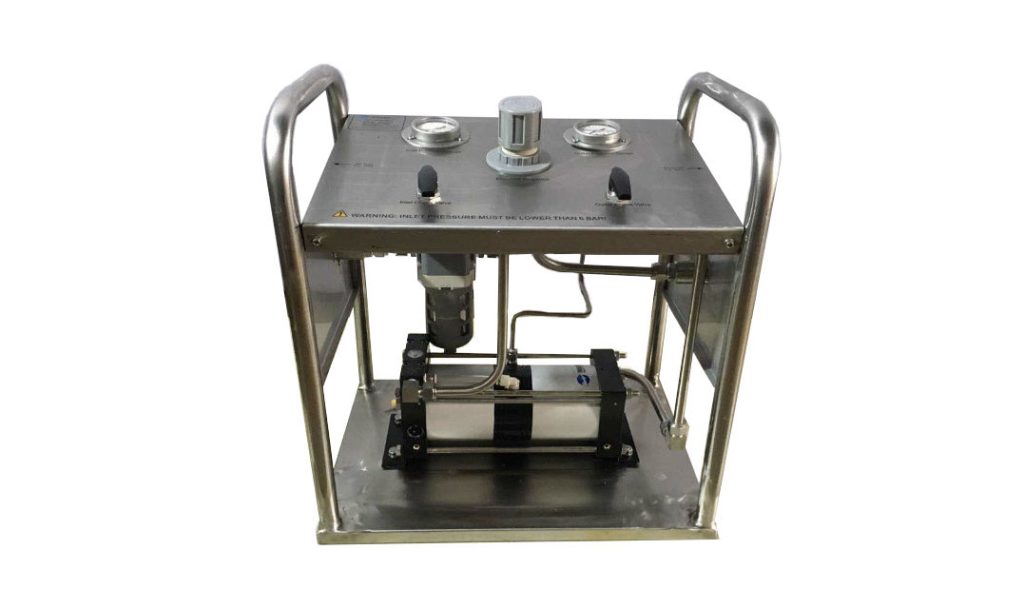
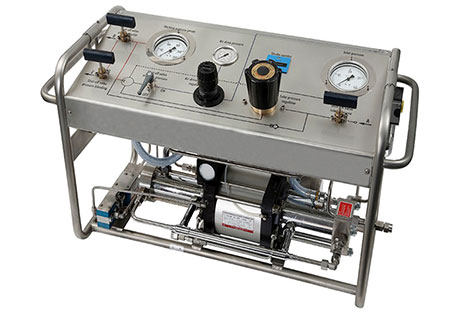
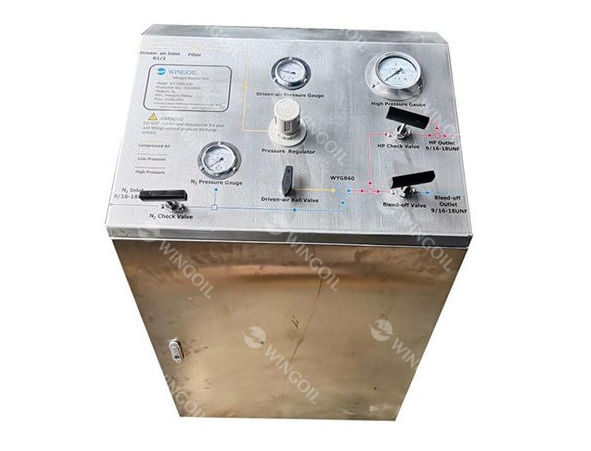
Wingoil Nitrogen Booster System integrates into it efficiency, portability, safety, and environmental conservation making it a perfect system for nitrogen applications needing to operate at high pressure. Its compact design gives an unloaded weight of about 80 kg that facilitates a mobile, as well as, an installed version.
Particular attention is paid to the material selection for the core components of the system such as the pump, valves, and pipes, which are all selected and made of stainless steel and are not vulnerable to heating due to high-pressure conditions, instead ensuring stable long-term regulation. The small foot-plate needs only compressed air for its working mode, and it is energy-saving, environmentally sound, and ideal for the pressurizing or filling-up of nitrogen into pressure vessels.
Key Features
Portable Boosting Design
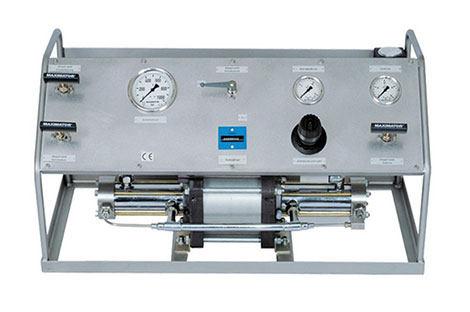
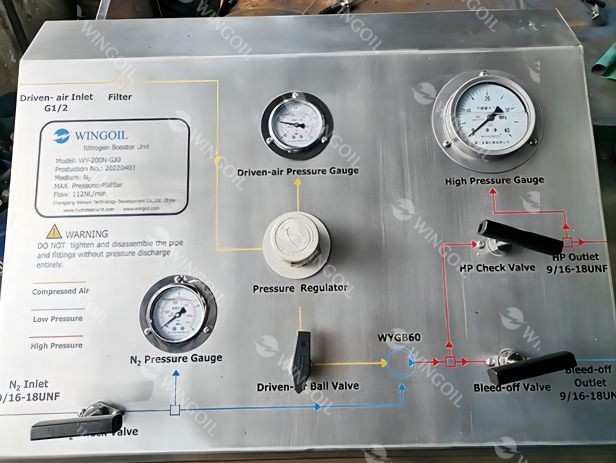
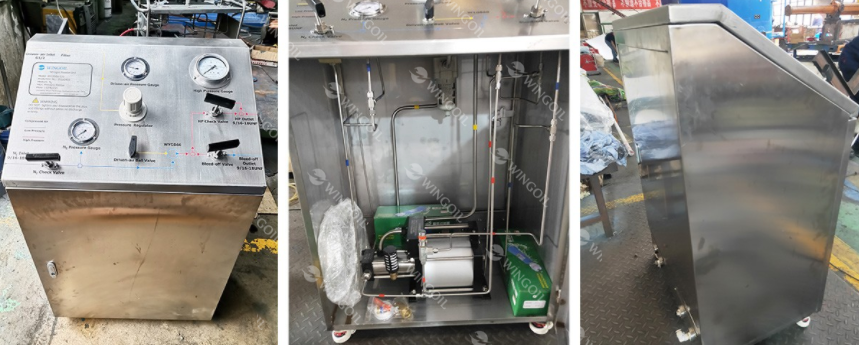
The combination of booster pump, pressure regulator, check valve, relief valve and pressure gauge is integrated in a compact setting. Its simplicity in design allows for easy operation in multiple working scenarios.
Safe and Environmentally Friendly Operation
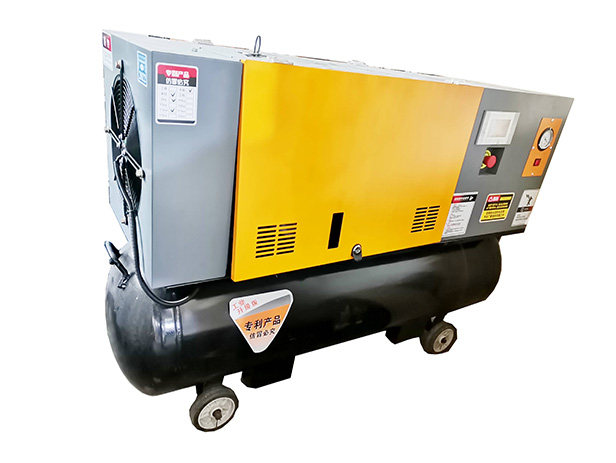
Drives with compressed air at low pressure, the system requires no electricity to work. This provides for safe and emission-free operation that meets current environmental standards in the industry.
Lightweight Cabinet Structure
With a lightweight overall design, the system can be easily fixed on-site or transported, offering flexible deployment for various applications.
Pressure Lock Function
Once the driving air pressure is set, the output pressure remains constant without any leakage, maintaining stable pressure without additional energy consumption, which improves operational efficiency.
Dual-Scale Anti-Vibration Pressure Gauge
The high-precision pressure gauge provides dual-scale readings and features anti-vibration construction, ensuring accurate and reliable pressure display, which enhances operational safety.
In Summary
Nitrogen booster pumps are necessary equipment in today’s industrial and laboratory control systems. They provide dependable high-pressure sources of nitrogen; but the efficient use of the pumps also results in increased production, system safety, and the reduction of energy use. Proper selection of the equipment model, regular maintenance, and application thereof under correct operating conditions promise to deliver maximum ROI for those acquiring industrial nitrogen booster pumps due to assured pressure solutions for a variety of industries in various cultural settings.
By having the Wingoil Nitrogen Booster System as an option, nitrogen boosting can be performed in a more efficient, safe, and environmentally-friendly manner, accomplishing greater flexibility in high-pressure nitrogen demands required in any industrial application.
Related Articles