Oxygen Booster Pump Explained: What Is It and How to Choose?
In modern oil and gas production, refining, and petrochemical operations, high-pressure pure oxygen plays an important role in various industrial processes. From catalytic cracking and underground crude oil gasification to cylinder filling on offshore drilling platforms and laboratory analysis, a stable and safe supply of high-pressure oxygen is essential for maintaining process continuity and operational safety.
However, because oxygen has strong combustion-supporting properties, oil and gas applications place extremely demanding requirements on boosting equipment. Conventional compressors and booster equipment may present significant risks, including oil contamination and ignition, severe corrosion, and insufficient explosion protection. As a result, an oxygen booster pump specifically designed for demanding industrial environments can provide an effective solution for oil and gas companies.
In this post, we will explore the key applications of oxygen booster pumps in the oil and gas industry, their major technical requirements, and how to select the right equipment for your application.
What is an Oxygen Booster Pump?
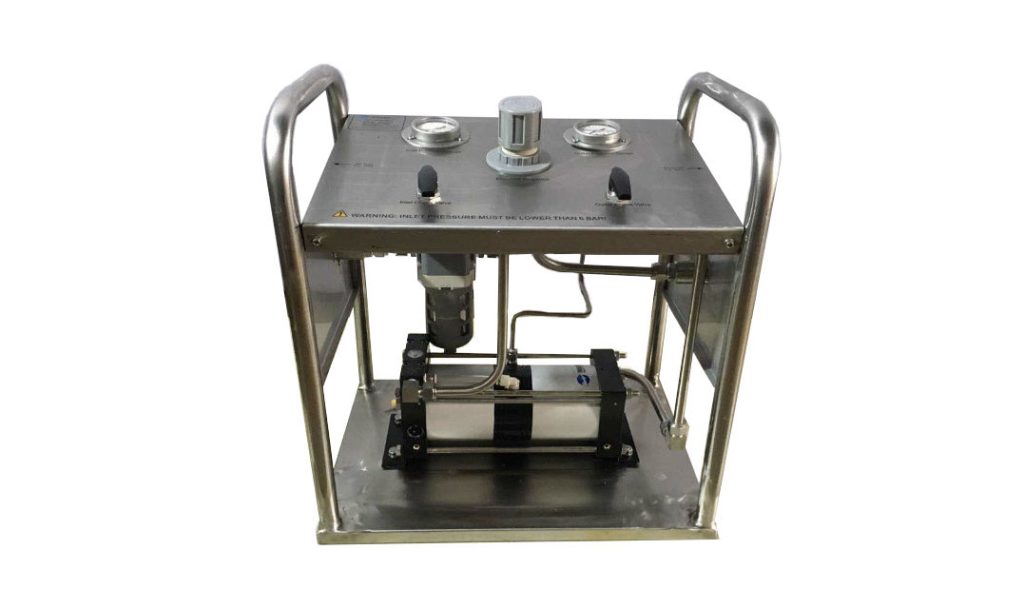
An oxygen booster pump is a gas boosting device designed to increase the pressure of oxygen. It typically receives low- or medium-pressure oxygen from an existing gas source and then compresses and boosts the gas to a higher pressure for downstream use.
Its basic working process can be understood as:
Low-Pressure Oxygen → Oxygen Booster Pump → Pressure Boosting → High-Pressure Oxygen → Downstream Equipment
The main difference between an oxygen booster pump and conventional gas transfer equipment is that its primary function is pressure boosting.
In Oil & Gas and other industrial high-pressure gas applications, an oxygen booster pump may be required when the existing oxygen supply pressure is insufficient to meet the operating or process requirements of downstream equipment.
It is important to note that oxygen is a gas with specific safety requirements. Therefore, materials, seals, lubrication methods, cleanliness, and the overall equipment design must be selected according to the actual oxygen service conditions.
How Does an Oxygen Booster Pump Work?
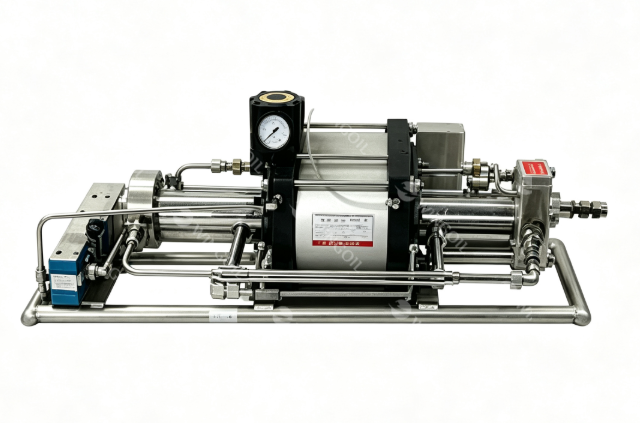
The specific structure of an oxygen booster pump varies depending on the drive method, pressure rating, and product design. However, the basic operating process generally consists of three main stages: oxygen inlet, compression and pressure boosting, and high-pressure discharge.
Low-Pressure Oxygen Supply
First, oxygen enters the booster pump from an existing gas source.
The inlet pressure depends on the actual oxygen supply system, such as a gas storage system, cylinder, or other oxygen source. When selecting equipment, it is important to determine the minimum inlet pressure, as the inlet pressure directly affects the operating condition and performance of the booster system.
Gas Compression and Pressure Boosting
After entering the equipment, the oxygen is compressed by the boosting mechanism.
During this process, mechanical energy or another driving force is converted into gas pressure, gradually increasing the oxygen pressure.
For high-pressure applications, the equipment must operate reliably within its design pressure range while providing the required flow rate and outlet pressure.
High-Pressure Oxygen Discharge
After being boosted, the high-pressure oxygen exits through the discharge outlet and enters downstream equipment or systems.
Depending on the application, the high-pressure oxygen may be supplied to gas storage systems, testing equipment, process equipment, or other high-pressure gas systems.
Therefore, when selecting an oxygen booster pump, it is important not to focus only on the maximum pressure. Inlet pressure, outlet pressure, and required flow rate should all be considered.
Types of Oxygen Booster Pumps
Depending on the drive method and application requirements, oxygen booster pumps can be configured in different ways.
Pneumatic Oxygen Booster Pumps
A pneumatic oxygen booster pump uses compressed air or another suitable driving gas as its power source.
This type of equipment can be used in certain industrial environments where high-pressure gas boosting is required. For Oil & Gas and other industrial applications, pneumatic drive systems can provide flexible equipment configurations according to site conditions.
However, their suitability must be confirmed based on the oxygen service conditions, drive gas, pressure requirements, and the manufacturer’s design specifications.
Electric Oxygen Booster Systems
Electric oxygen booster systems use an electric motor as the power source and can be integrated with other control systems.
For fixed industrial installations, electric drive systems can be configured according to specific production requirements.
However, for oxygen applications, the electrical configuration and the design of all components that come into contact with oxygen still need to be professionally evaluated based on the actual operating conditions.
High-Pressure Oxygen Booster Pumps
For industrial applications requiring higher outlet pressures, a dedicated high-pressure oxygen booster pump may be used.
These systems typically require careful consideration of:
- Maximum outlet pressure
- Inlet pressure
- Flow rate
- Material compatibility
- Seal compatibility
- Oxygen cleanliness
- Operating temperature
- Duty cycle
Therefore, high-pressure oxygen boosting equipment should not be selected based on pressure alone. The complete operating conditions of the system must be considered to ensure proper equipment matching.
Applications of Oxygen Booster Pumps in Oil & Gas
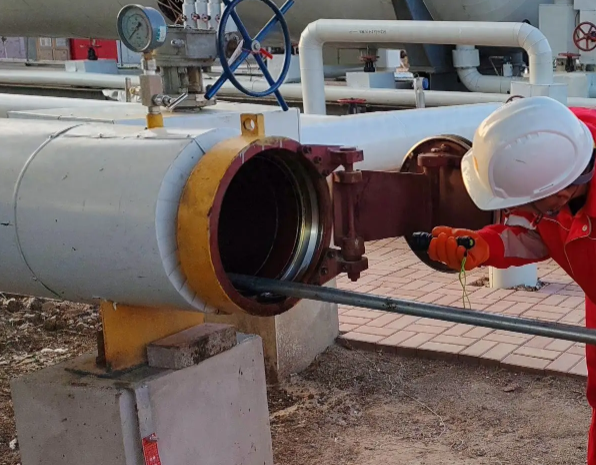
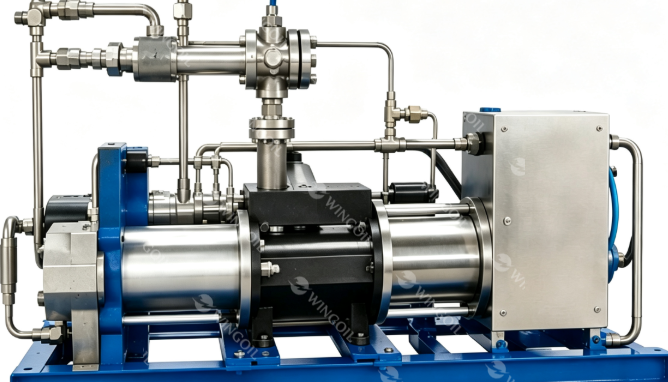
In the Oil & Gas industry, the actual application of an oxygen booster pump depends on the specific process and gas requirements. For applications involving high-pressure gas handling, testing, and equipment maintenance, a booster system may serve as an important part of the overall pressure system.
Pressure Testing
High-pressure pressure testing is an important part of the oil and gas industry.
Valves, pipelines, pressure control equipment, and other pressure-containing equipment may require appropriate pressure verification before being put into operation.
In specific gas testing applications, an oxygen booster pump may be used to increase oxygen pressure to the required range.
The appropriate test medium and test pressure should be determined according to equipment design, project requirements, and applicable standards.
Pipeline and Equipment Testing
The Oil & Gas industry involves extensive pipeline networks and high-pressure equipment.
During equipment installation, maintenance, or commissioning, certain systems may require gas pressure-related testing.
In these applications, stable pressure control is important for maintaining a consistent testing process.
Wellhead and Production Equipment
Wellhead and production equipment typically operate under relatively high pressure conditions.
For applications requiring high-pressure gas for testing, maintenance, or specific process operations, an appropriate gas booster system can form part of the overall pressure system.
If a project involves:
- Wellhead Equipment
- Christmas Tree
- Blowout Preventer
- API 6A Valves
- Surface Manifold
the suitability of an oxygen booster pump or another type of gas booster equipment should be determined according to the specific testing procedure and application requirements.
Gas Charging and Pressurization
In some industrial systems, gas must be increased from a lower pressure to a specified pressure before it can meet the requirements of downstream equipment.
In such cases, a booster system can provide additional pressure-boosting capability.
In actual applications, the appropriate boosting equipment should be selected based on the gas type, target pressure, flow rate, and equipment compatibility.
Oilfield Maintenance and Commissioning
Oilfield operations often involve various equipment maintenance, commissioning, and field service requirements.
For specific operations requiring high-pressure gas, portable or field-ready booster systems can be configured according to project requirements.
Whether the equipment is suitable for field use should be evaluated based on environmental conditions, drive method, pressure rating, transportation requirements, and installation conditions.
Why Use an Oxygen Booster Pump in Oil & Gas Applications?
In industrial systems where higher oxygen pressure is required, the primary purpose of an oxygen booster pump is not to generate oxygen, but to make full use of an existing oxygen source and further increase its pressure.
Higher Output Pressure
An oxygen booster pump can increase the pressure of an existing oxygen source to a higher level, helping meet the requirements of specific downstream equipment or processes.
Compact Pressure Boosting Solution
For applications that only require additional gas pressure, a booster system can serve as a pressure-boosting unit between the existing gas source and downstream equipment.
Pressure Control
A properly selected booster system can help the system reach the required operating pressure.
In practical projects, equipment should be selected according to inlet pressure, outlet pressure, and flow requirements rather than relying solely on the maximum rated pressure.
Flexible System Integration
Depending on project requirements, an oxygen booster pump can be integrated with gas storage equipment, pipelines, valves, pressure gauges, and control systems to form a complete gas boosting system.
For Oil & Gas projects, system integration capability is also an important factor to consider when selecting equipment.

Oxygen Booster Pump vs. Gas Booster Pump
In industrial gas applications, an oxygen booster pump and a gas booster pump may have some functional similarities, but they should not simply be considered the same type of equipment.
| Comparison | Oxygen Booster Pump | General Gas Booster Pump |
| Primary Medium | Oxygen | Different gases depending on product design |
| Main Function | Increase oxygen pressure | Increase gas pressure |
| Key Requirement | Oxygen compatibility | Gas compatibility |
| Important Considerations | Cleanliness, materials, seals, and oxygen service suitability | Gas type, pressure, flow rate, and material compatibility |
| Application Scope | Dedicated oxygen boosting systems | A wider range of industrial gas applications |
Therefore, if a project involves oxygen, you should not assume that a conventional gas booster pump is suitable simply because it can handle other gases.
The equipment must be evaluated according to the actual gas medium and the manufacturer’s technical specifications.
How to Choose an Oxygen Booster Pump for Oil & Gas
When selecting an oxygen booster pump, it is recommended to consider the following key parameters.
1. Required Inlet and Outlet Pressure
First, determine the inlet pressure and target outlet pressure of the oxygen supply.
When selecting equipment, do not look only at the maximum pressure. Make sure that the actual operating pressure falls within the equipment’s permitted operating range.
2. Required Flow Rate
In addition to pressure, you also need to consider the required oxygen flow rate.
It is recommended to evaluate the inlet pressure, outlet pressure, and operating time to determine whether the booster pump can meet the actual process requirements.
3. Oxygen Compatibility
Oxygen applications have stringent safety requirements. Therefore, you need to confirm whether the pump’s materials, seals, lubrication method, and internal cleanliness are suitable for oxygen service.
4. Operating Environment and Duty Cycle
Depending on whether the equipment will be used in an oilfield, testing facility, offshore platform, or remote field location, select an appropriate structure and drive method.
At the same time, determine whether the equipment will operate intermittently or continuously to ensure reliable performance.
5. System Integration
If the booster pump needs to be integrated into an existing system, also consider the piping, valves, pressure gauges, control systems, and safety devices to ensure that the complete oxygen boosting system can operate reliably.
Reliable Choice: Wingoil Oxygen Booster
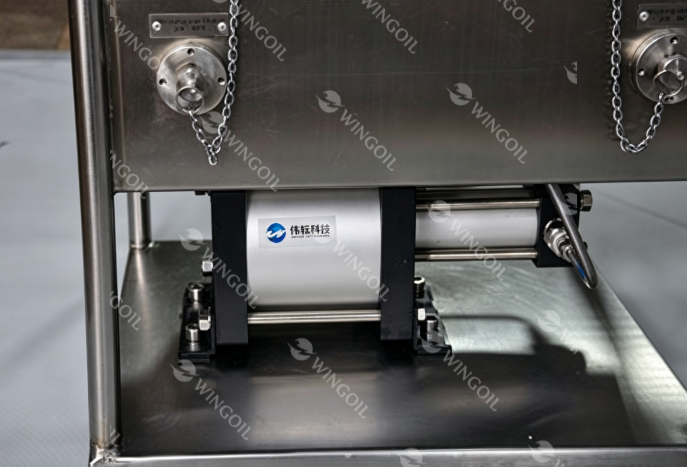
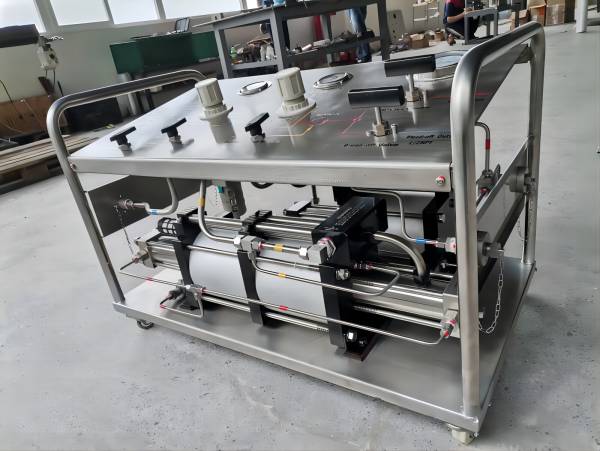
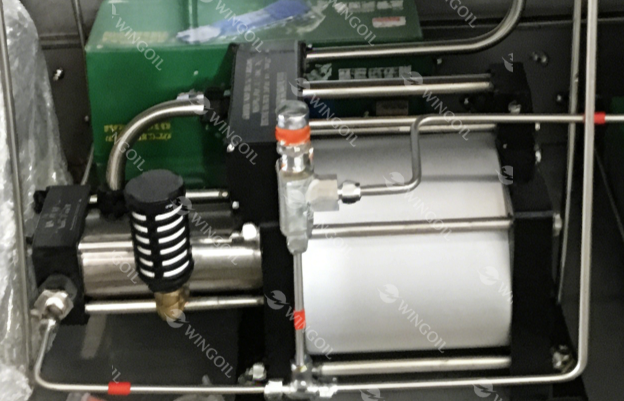
Wingoil Oxygen Booster is a high-pressure gas boosting solution designed for high-pressure gas testing, filling, recovery, and other high-pressure applications, serving the Oil & Gas and related industrial sectors.
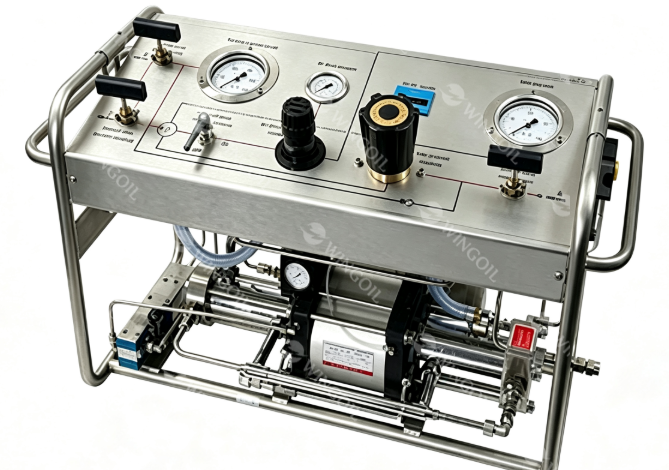
Wingoil can customize O₂ Booster Stations according to specific operating conditions and pressure requirements. The system can be configured with components such as pressure switches, pneumatic or electric directional valves, connection fittings, high-pressure hoses, pressure filters, and control valves, providing complete high-pressure gas boosting solutions for different applications.
If you are looking for an oxygen booster pump suitable for specific pressure, flow rate, and gas service requirements, Wingoil can provide a customized boosting solution based on your application needs.
Related Articles