BOP Control System Explained: How BOPs Are Controlled Safely?
In the oil and gas drilling industry, safety is never an option, it is the baseline of all operations. Among all safety equipment on a drilling site, the Blowout Preventer (BOP) System is universally recognized as the “last line of defense” against catastrophic blowouts.
However, no matter how robust the BOP stack itself is, it cannot function at critical moments without a stable, reliable “brain and heart” to drive it. This brain and heart is the BOP Control System. This article will take you deep into the core components, working principles, common troubleshooting methods, and API standards of BOP control systems, as well as how to choose a high-reliability well control solution.
What is a BOP Control System? How Does It Work?
BOP Control System (Blowout Preventer Control Unit, commonly known as an “accumulator” or “Koomey Unit”) is the central safety control hub of a drilling operation. Its primary function is to provide high-pressure hydraulic fluid to rapidly and forcefully close the Blowout Preventer (BOP) stack during an emergency (such as a well kick or blowout), sealing the wellbore and preventing a catastrophic disaster.
How Does It Work?
1. Energy Storage (Accumulation Phase)
The system utilizes electric or air-driven pumps to force hydraulic oil into accumulator bottles pre-charged with high-pressure nitrogen gas (N₂). Since liquid is incompressible and gas is compressible, the nitrogen is highly compressed, raising and maintaining the system pressure at a standby state of 3,000psi. This stored energy acts as a failsafe reserve that can be deployed even during a total rig power failure.
2. Signal Transmission & Redirection (Control Phase)
When the driller presses a close command on the remote control panel on the drill floor, a signal (pneumatic, electric, or hydraulic) is sent to the control manifold of the main unit. The directional control valves (3-position, 4-way valves) inside the manifold quickly shift, opening the high-pressure fluid pathway.
3. Execution (Hydraulic Actuation)
The high-pressure hydraulic fluid rushes directly into the operating cylinders of the BOP stack:
- Ram Preventers: It drives opposing pistons inward to clamp tightly around the drill pipe or completely shear through the drill string (shear rams).
- Annular Preventers: It forces a large piston upward to compress the rubber packing element inward, sealing around any shape in the wellbore or closing off an empty hole.
Why is the BOP Control System So Important?
If the BOP stack is a sturdy “shield,” the BOP control system is the “arm” that wields it. Its critical importance is reflected in the following irreplaceable dimensions:
Mitigating Catastrophic Accidents
Well control failures can escalate into global disasters like the “Deepwater Horizon.” A reliable control system ensures a response within seconds, killing the accident in its tracks.
Protecting Human Lives
Frontline personnel on drilling rigs face immense operational risks. The BOP control system is the final line of defense protecting the lives of oilfield workers.
Asset and Environmental Protection
It prevents tens or hundreds of millions of dollars of rig equipment from being destroyed while strictly preventing crude oil and natural gas leaks into marine or terrestrial environments, avoiding astronomical environmental fines.
Strict Regulatory Compliance
Energy regulatory authorities worldwide (such as BSEE in the US, National Energy Administration in China, etc.) have established incredibly stringent laws. No drilling operation is allowed to spud before the BOP control system passes rigorous annual inspections and on-site testing.
Main Types of BOP Control Systems
Depending on the operational environment, water depth, and well depth, BOP control systems are mainly classified into the following categories:
By Operational Environment:
Surface BOP Control System:
Primarily used for land drilling, workover operations, and shallow-water jack-up platforms. In these systems, the control unit is placed in a non-hazardous zone far from the wellhead, and hydraulic fluid is connected directly to the surface BOP via high-pressure hoses or hard piping.
Subsea BOP Control System:
Used for deepwater drilling (semi-submersible rigs or drillships). Because the BOP stack sits on the seabed thousands of meters below, traditional surface hydraulic signals experience severe “signal delay” due to pipe friction. Therefore, deepwater systems must utilize a Multiplex (MUX) System, sending electrical signals via fiber optics or cables to subsea control pods, where local subsea accumulators instantly execute the action.
By Control Mechanism:
Direct Hydraulic:
The most traditional method, combining pure mechanics and hydraulics. It offers excellent stability and is widely used on land.
Electro-Hydraulic:
Replaces hydraulic pilot signals with electrical signals, offering ultra-fast response speeds. It is commonly used on modular rigs and offshore drilling.
Acoustic Control System:
Serves as the tertiary, ultra-emergency backup system for deepwater operations. If the cables and hydraulic lines connecting to the surface are completely severed, the mother vessel can transmit underwater acoustic waves to trigger the subsea BOP’s shear rams for a forced cut.
BOP Control System Troubleshooting, Solutions, and Maintenance
On an oilfield site, the BOP control system must achieve a “Zero-Failure” rate. Understanding common pain points and conducting preventive maintenance is a core responsibility for field engineers.
| Common Faults | Root Cause | Action / Solution |
| Unexplained accumulator pressure drop | Nitrogen (N₂) bladder leakage inside the accumulator bottles, or internal leakage due to poor sealing of the hydraulic check valve. | Use specialized tools to check the pre-charged nitrogen pressure; replace damaged bladders; clean or replace check valve seals. |
| Control valve (3-position 4-way valve) jammed/inoperable | Hydraulic oil contamination (containing iron filings, sand, or water), leading to mechanical wear or jamming of the valve core. | Thoroughly flush the hydraulic system; regularly replace high-pressure filter elements; filter or replace the hydraulic fluid. |
| BOP closing time too long (slow actuation) | Insufficient flow output from hydraulic pumps (pneumatic/electric), or partial blockage in the control lines. | Inspect and repair hydraulic pump seals; clean line filters; recalibrate the system main pressure regulating valve. |
| Electrical control signal interruption or loss of communication | Corrosion of electrical terminals due to high salt spray offshore, or damage to the cable between the surface and the BOP. | Use a Time-Domain Reflectometer (TDR) to locate the break point; upgrade junction boxes and connectors to a high protection rating (e.g., IP68/marine grade). |
Relevant Industry Standards for BOP Control Systems
For international buyers screening global suppliers, industry standard certifications are the very first mandatory threshold.
API Spec 16D (American Petroleum Institute): The standard specification for Control Systems for Drilling Well Control Equipment and Control Systems for Diverter Equipment. It is the “Bible” of global BOP control system manufacturing, setting strict quantitative regulations on accumulator capacity, backup pump redundancy (e.g., mandatory dual backup with electric and pneumatic pumps), and closing times (e.g., closing an annular BOP smaller than 18-3/4 inches must be completed within 30 seconds).
API Spec 16A: Specification for the design and manufacture of the BOP body itself (rams, annulars, and spools).
NACE MR0175 / ISO 15156: Materials standard for resistance to hydrogen sulfide (H₂S) stress cracking. If the equipment is used in sour oil and gas fields containing H₂S, the valve bodies and core piping materials must comply with this standard.
ISO 13533: International Organization for Standardization standard for drilling and production equipment in the petroleum and natural gas industries, which is highly aligned with API standards.
Wingoil BOP Control and Pressure Testing Systems: Uncompromising Safety for Global Drilling
In oil and gas drilling operations, a reliable BOP pressure test pump is critical to ensuring operational safety. As a vital safety device at the wellhead, the blowout preventer (BOP) must undergo rigorous high-pressure and sealing tests to effectively withstand extreme downhole pressures and prevent major safety risks such as equipment leakage, failure, and blowouts.
Wingoil BOP Control System is engineered precisely to meet this core requirement.
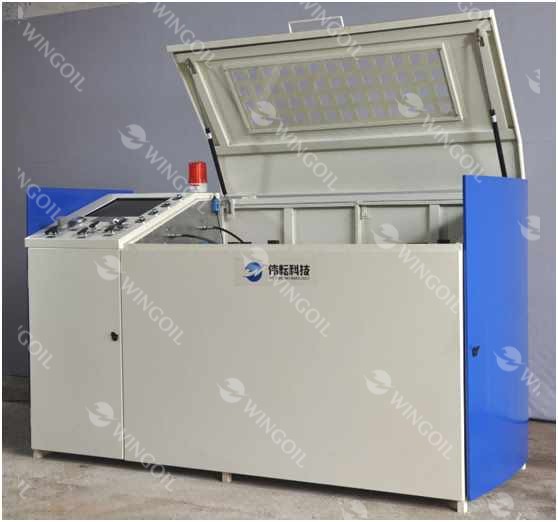
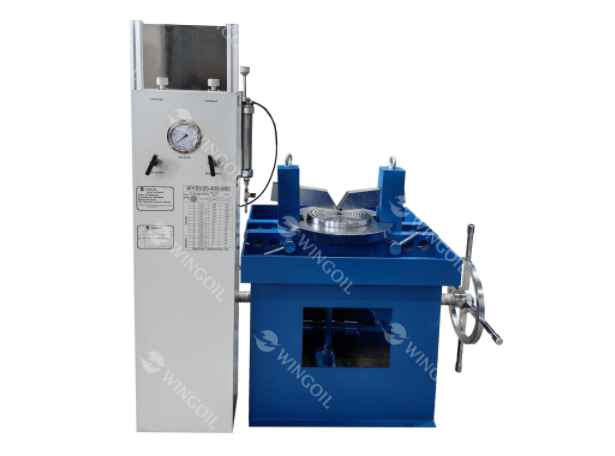
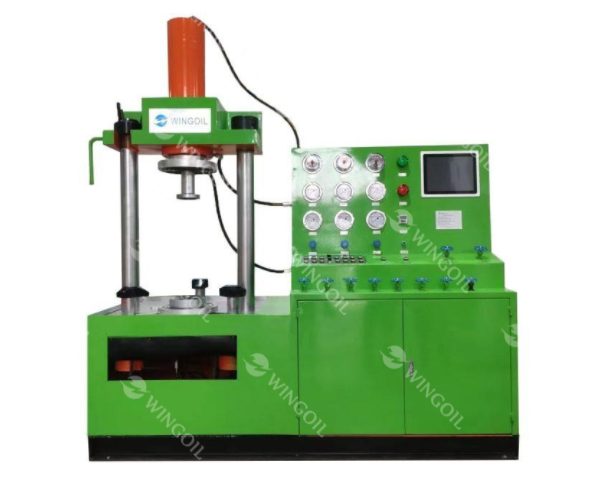
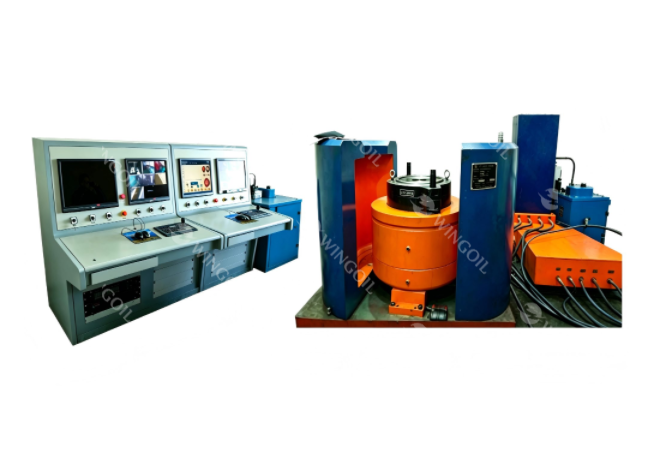
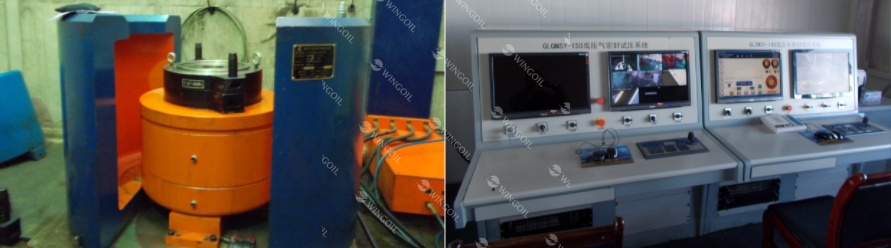
This equipment is specially designed to perform hydrostatic strength and sealing performance testing on well control equipment and wellhead assemblies after maintenance. It is perfectly compatible with the full range of pressure testing scenarios for core oil and gas drilling and production equipment, including the BOP stack and Christmas Tree, covering factory inspection, maintenance/overhaul, and re-certification.
Core Solutions and Features
Safety & Layout: Features a “man-machine separation” safety layout to effectively mitigate high-pressure operational risks. It supports multi-station independent operations, allowing separate parameter settings and independent pressure-holding for each station.
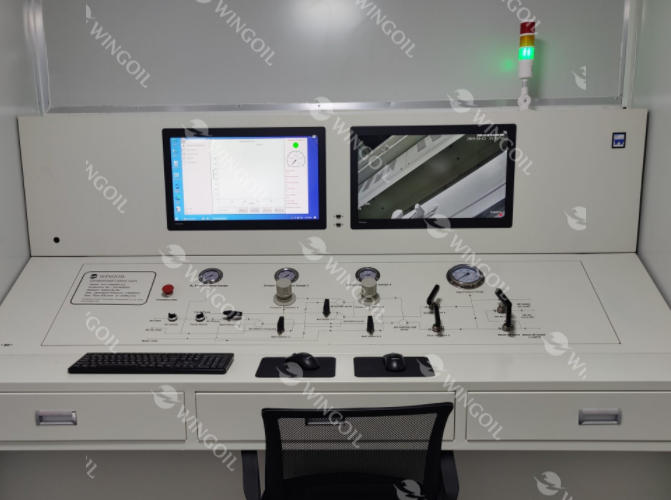
Fully Automated Control: Integrates automated control logic to seamlessly handle the entire testing sequence, including automatic pressure ramp-up, stepped pressure holding, and gradual pressure relief.
Data Traceability: Real-time data acquisition captures pressure changes, automatically stores records, and plots pressure-time curves. Standardized test reports can be generated with a single click.
Multi-Layer Protection & Explosion-Proof: Equipped with overpressure automatic shutdown, emergency pressure relief, audio-visual alarms, and manual emergency venting. The electrical and control units fully comply with oilfield explosion-proof (Ex) requirements.
Precision Testing & Sealing Evaluation: Accurately evaluates structural stability and component sealing performance under extreme high pressures, pinpointing micro-leaks to eliminate drilling hazards caused by non-compliant BOP performance at the source.
Contact Wingoil Share your Request for Customization, and we will provide you with a detailed technical proposal and commercial quotation tailored to your specific drilling needs.
Related Articles