PSV Test Bench: What Is It and How to Choose the Right One?
In high-pressure environments like oil & gas, chemical processing, and power plants, the Pressure Safety Valve (PSV) acts as the ultimate equipment “lifesaver.” When pressure inside a pipeline or reactor exceeds safe limits, the system relies entirely on the PSV to snap open and relieve the pressure instantly.
But have you ever stopped to think: What happens if this critical safety valve gets stuck or starts leaking prematurely?
That is precisely why industrial facilities must conduct regular “health checkups” on their valves using a PSV Test Bench. Today, we’ll take an in-depth look at PSV test benches to help you fully understand this vital high-pressure testing equipment and guide you on how to choose the right system for your operations.
What is a PSV Test Bench?
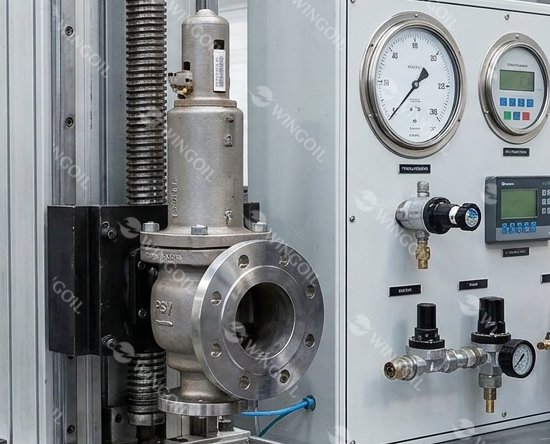
A PSV Test Bench is a specialized testing apparatus engineered to evaluate the performance of Pressure Safety Valves (PSVs) and Pressure Relief Valves (PRVs).
By applying controlled pressure to the valve, the test bench simulates real-world operating conditions to measure performance across critical pressure points, including:
Set Pressure: Does the valve pop open precisely at its predetermined pressure setpoint (e.g., 10 bar)? (Opening too early interrupts production; opening too late risks catastrophic failure.)
Seat Tightness / Sealing Integrity: Does the valve leak gas bubbles or liquid before reaching its set pressure? (Preventing loss of expensive raw materials and dangerous fugitive emissions.)
Reseating Pressure: After relieving the excess pressure, does the valve reseat promptly and seal tightly once again?
Why is PSV Testing Essential?
The Safety Valve (PSV) is the “last line of defense” for high-pressure vessels, storage tanks, and piping networks. Over prolonged operation, factors like spring fatigue, seat wear, fluid corrosion, and particulate scaling can cause set pressure drift or valve core seizure.
If a PSV fails, the best-case scenario is process fluid leakage and unscheduled downtime; the worst-case scenario is catastrophic equipment rupture and severe safety incidents. Utilizing a professional PSV Test Bench for periodic offline testing provides three core benefits:
1. Precise Opening Verification to Safeguard Operations
Simulates true high-pressure conditions to accurately measure set pressure and reseating pressure, ensuring the valve fully opens for relief the exact moment system pressure reaches critical levels.
2. Regulatory Compliance & Audit Preparation
Complies with API 527, ASME Section VIII, and specialty equipment inspection codes. The automated data capture system creates uniform and tamper-free test certificates for easy audit purposes, FATs (Factory Acceptance Tests), and post-repair inspections.
3. Early Detection of Smaller Faults To Increase Valve Longevity
Early diagnosis of seat micro-leaks and fatigue of parts before complete valve failure. Early detection reduces the risk of unscheduled shutdowns and costs of spare part replacements.
Working Principle & Testing Steps of PVS Test Bench
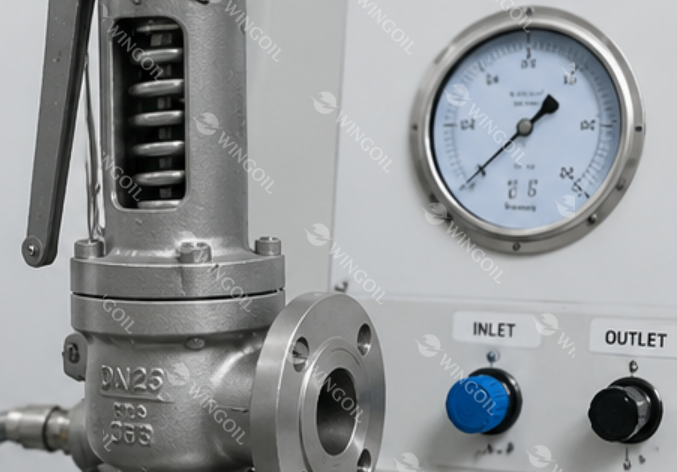
A PSV Test Bench utilizes an integrated high-pressure power unit to incrementally feed gas or liquid media into a securely clamped safety valve. The standard testing process consists of five main steps:
Step 1. Valve Clamping & Sealing Position
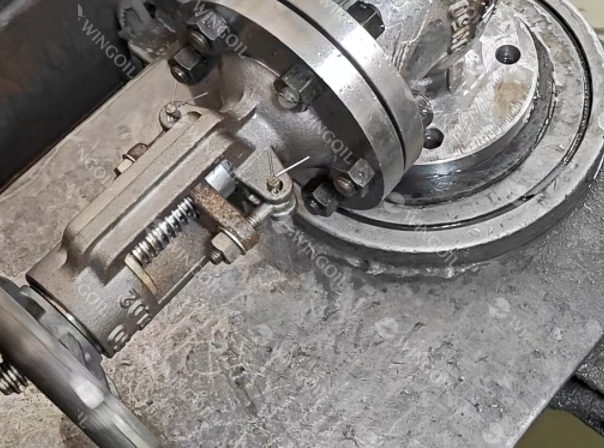
The target PSV is mounted on the bench using adaptive adapters. A hydraulic clamping system activates three or four synchronous jaws, applying sufficient clamping force to guarantee absolute inlet sealing and rock-solid stability under high pressure.
Step 2. Staged & Smooth Pressurization
The test medium is selected based on valve type (high-pressure nitrogen/compressed air for gas valves; demineralized water/oil for liquid valves). Liquid/gas booster pumps slowly ramp up pressure in smooth stages toward the designated set pressure.
Step 3. Set Pressure Capture
The moment the valve opens at critical pressure, a high-frequency pressure sensor captures the exact popping peak. The system plots a “Pressure vs. Time” curve and evaluates set pressure variance against API/ASME tolerances.
Step 4. Seat Tightness & Leakage Detection
Post-pop, the pressure is reduced to approximately 90% of the set pressure to verify seat sealing. Gas valves are tested via bubble counting (or optical sensors) according to API 527, while liquid valves are assessed by collecting and measuring liquid droplets.
Step 5. Depressurization & Report Generation
Upon completion, the system automatically vents test pressure. Software compiles set pressure, reseating pressure, and leakage rate metrics into an unalterable digital report for quality control and compliance archiving.
Core Application Fields of PSV Test Bench
Different industries have distinct media requirements, pressure classes, and compliance standards. PSV Test Benches play an indispensable safety role across these major sectors:
Oil and Gas Industry
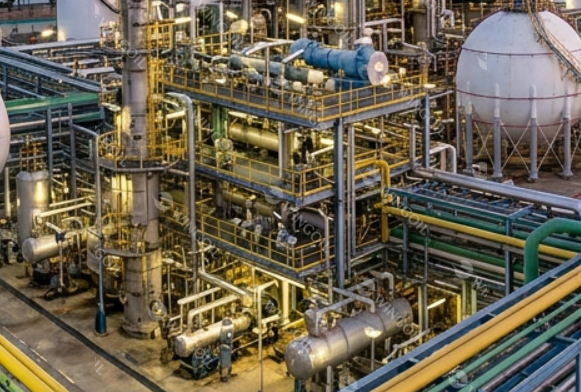
High pressure and flammable fluids are used at each stage in the industry – upstream, midstream, and downstream processes. Safety valve testing equipment is used to test the safety valves of onshore wells, subsurface Christmas trees, compressor stations, and offshore oilrigs.
Chemical Processing Industry
High temperatures, pressures, and corrosive chemicals are involved. Testing facilities are needed to test safety valves of high-pressure reactors, hydrotreaters, LPG storage vessels, and pipelines.
Energy Production Sector
Houses fossil fuel plants and nuclear power plants which contain huge amounts of thermal energy and pressure. The test bench tests safety valves in the main steam, superheater relief valve, and feedwater heater valve to release pressure rapidly during abnormal conditions.
Valve Fabrication & Service
Acts as the final quality assurance instrument. Fabrication plants use test benches for pre-factory pressure setting, seal sampling, and baseline data recording while the service shop utilizes test benches to reset recalibrated valves according to factory requirements.
Portable vs. Stationary Test Benches: Which Fits Your Needs?
Commercial PSV test benches generally fall into two categories depending on operational needs:
| Comparison Item | Portable Test Bench | Heavy-Duty Stationary Test Bench |
| Form Factor | Compact, resembling a rugged wheeled case | Large machine frame fixed to shop floor |
| Ideal Application | Offshore platforms, remote pipelines, emergency field service | Valve factories, third-party labs, centralized workshops |
| Testing Capacity | Small-to-medium sizes, low-to-medium pressures | Large bores (e.g., 12″+), ultra-high pressure flanged valves |
| Key Advantage | High mobility—takes testing directly to the field | Massive clamping force, rich features, high safety rating |
Selection Tip: If your plant manages high routine maintenance volumes, install a stationary bench in your main shop. If you manage remote assets or elevated/field piping, supplement it with a portable unit.
How to Select the Right PSV Test Bench?
Purchasing a PSV Test Bench is a long-term investment in plant safety and maintenance efficiency. Evaluate prospective models across four key dimensions:
Pressure Range & Media Compatibility
Identify the highest set pressure and pressure class across your valve inventory (e.g., Class 150 to Class 2500). Choose a test bench with a maximum pressure capacity that leaves a 20%–30% safety margin. Ensure correct media capability: gas testing requires a high-pressure gas booster circuit (N2 or air), while liquid testing requires hydraulic pumps and a media reservoir.
Valve Size (DN) & Clamping Force
Verify the bench’s dimensional span and clamping power against your minimum and maximum valve sizes (e.g., DN15 to DN400) and connection types (flanged, threaded, welded). For facilities servicing diverse valve sizes, choose an adjustable hydraulic 3-jaw/4-jaw clamping system. For large-bore, high-pressure flanged valves, ensure adequate hydraulic tonnage to prevent leakage or ejection hazards.
Automation Level & Operational Efficiency
Manual/Semi-Automatic Benches: Use manual needle valves for pressurization and relief. Suitable for low-frequency testing or budget-conscious shops, though highly dependent on operator skill.
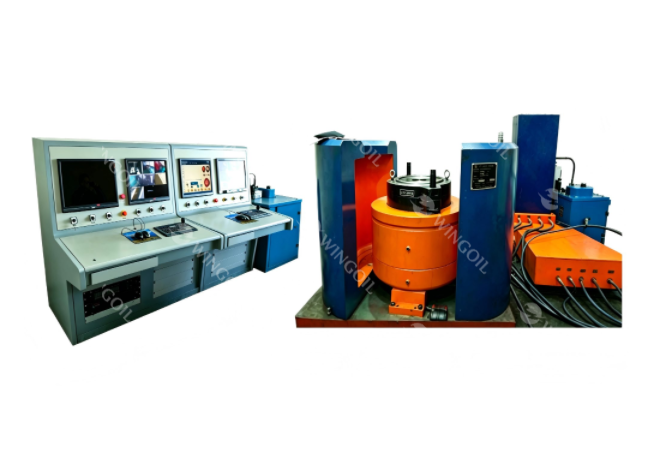
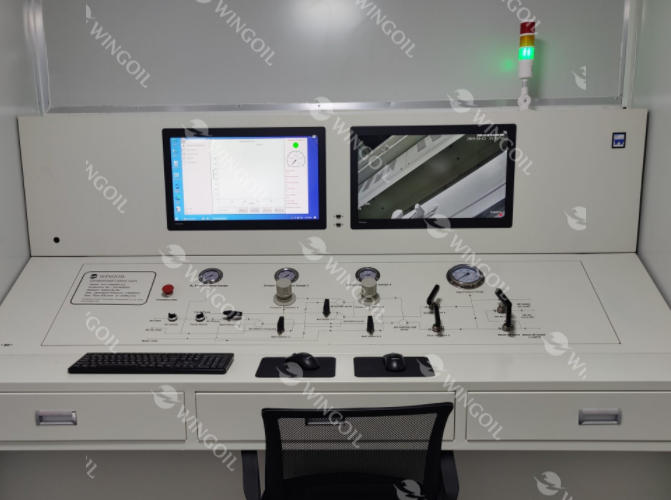
Fully Automatic Benches: Utilize PLC systems and electro-hydraulic proportional valves to automate ramp-up, set point capture, and reseat evaluation. Ideal for valve manufacturers, test centers, or major plant turnarounds, dramatically lowering cycle times and human error.
Data Acquisition & Traceability
For regulated industries, data integrity is paramount. Prioritize benches equipped with high-frequency pressure sensors and control software that generate real-time Pt (Pressure-Time) dynamic curves, log set/reseat values, and export API 527/ASME compliant digital reports directly into your plant’s ERP or CMMS.
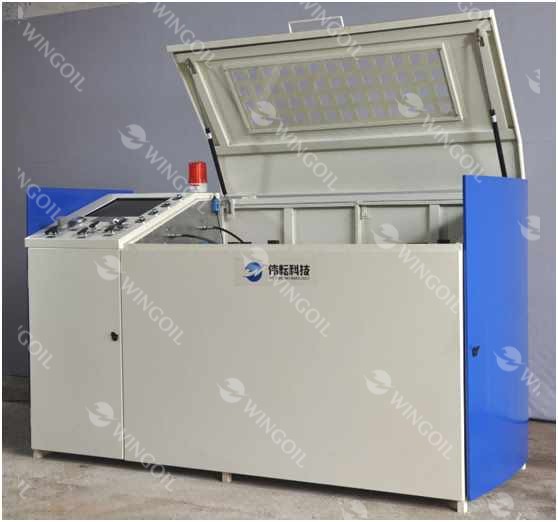
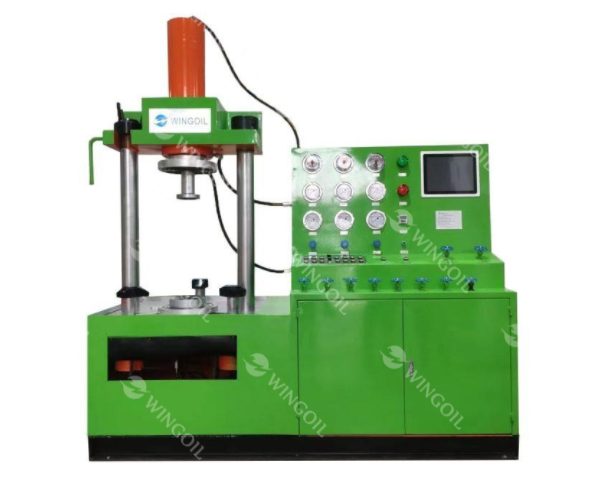
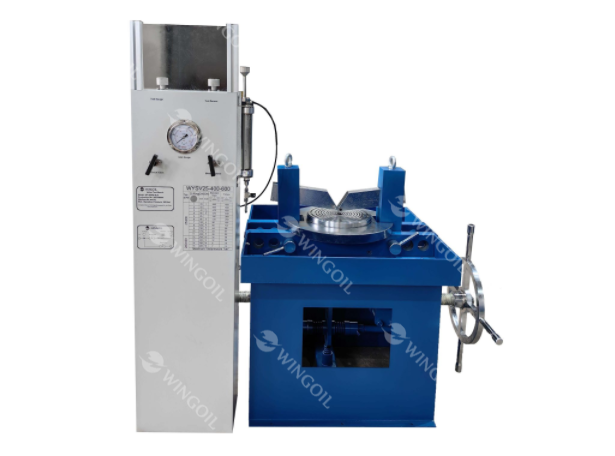
Wingoil Safety Relief Valve Test Bench for PSV
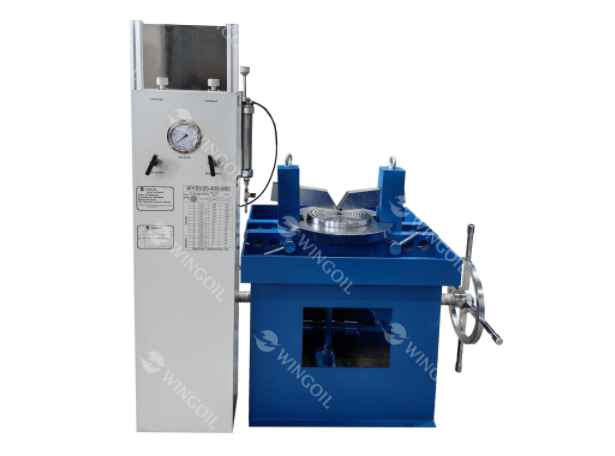
Wingoil Safet Relief Valve Test Bench is a precision manual safety valve test bench specifically engineered for the oil & gas, chemical, and power industries. Designed to calibrate set pressure and assess seat tightness on a wide range of flanged PSVs, SRVs, and PRVs, it fully complies with API 527 and ASME standards.
Key Features & Highlights:
Smooth High-Pressure Control: Reaches working pressures up to 60 MPa (600 bar), with maximum valve pressure resistance up to 20,000 psi (140 MPa). Features an integrated micro-throttling valve for precise pressure adjustment and stabilization.
Integrated Quick-Clamping & Sealing: Features an integrated seal groove design paired with multi-size sealing rings and a manual clamping mechanism to quickly adapt to various valve sizes, ensuring zero leakage during high-pressure testing.
Accurate Bubble Leak Detection: Equipped with a standard API 527 bubble counter to visually and accurately evaluate seat micro-leakage and seal stability.
Pneumatic Boosting & Enhanced Safety: Driven by air-driven liquid/gas boosters (0–70 MPa) with built-in filter-regulators and high-pressure self-locking safety features. Requires no complex electrical infrastructure, making it ideal for harsh industrial environments and shop floors.
Need customized solutions or detailed product documentation? Contact Wingoil today!
Related Articles